For US Healthcare Professionals


- Wakefulness
- Daytime sleepiness
- Cataplexy
- Symptom severity

ORZEYFUL was evaluated in two phase 3, randomized, multicenter, double‑blind, placebo-controlled, 12‑week, parallel-group studies1
PRIMARY ENDPOINT
Wakefulness: Statistically significant improvement1
As measured by the Maintenance of Wakefulness Test (MWT) vs placebo at week 12 (P<0.001)1,2
Change from baseline vs placebo at week 121
Treatment arm | Baseline mean (SD) | LS mean difference from placebo (95% CI) | |
FirstLight Study | 1 mg*† | 5.5 (7.7) minutes | 13.8 (10.2, 17.4) |
| 2 mg*† | 4.4 (5.5) minutes | 17.2 (13.7, 20.7) | |
| Placebo* | 5.1 (6.8) minutes | ||
RadiantLight Study | 2 mg*† | 4.8 (4.9) minutes | 20.1 (16.6, 23.6) |
| Placebo* | 4.1 (4.9) minutes |
Treatment arm | |
FirstLight Study | 1 mg*† |
| 2 mg*† | |
| Placebo* | |
RadiantLight Study | 2 mg*† |
| Placebo* |
Baseline mean (SD) | |
FirstLight Study | 5.5 (7.7) minutes |
| 4.4 (5.5) minutes | |
| 5.1 (6.8) minutes | |
RadiantLight Study | 4.8 (4.9) minutes |
| 4.1 (4.9) minutes |
LS mean difference from placebo (95% CI) | |
FirstLight Study | 13.8 (10.2, 17.4) |
| 17.2 (13.7, 20.7) | |
RadiantLight Study | 20.1 (16.6, 23.6) |
*Twice daily, at least 3 to 5 hours apart.1
†Statistically significantly superior to placebo after adjusting for multiplicity.1
- ORZEYFUL 1 mg (FirstLight Study) and 2 mg (both studies) significantly increased mean sleep latency from baseline to week 12 compared to placebo1
FirstLight Study patients experienced on average1,‡:
361% increase in time awake
with ORZEYFUL 2 mg
227% increase in time awake
with ORZEYFUL 1 mg
25% decrease for patients treated with placebo
RadiantLight Study patients experienced on average1,‡:
398% increase in time awake
with ORZEYFUL 2 mg
24% decrease for patients treated with placebo
‡ Percent change from baseline to week 12 was calculated as the within-group LS mean change from baseline to week 12 divided by the baseline mean x 100. LS mean change from baseline; FirstLight Study placebo: -1.3 (1.5), ORZEYFUL 1 mg: 12.5 (1.3), ORZEYFUL 2 mg: 15.9 (1.2). RadiantLight Study placebo: -1.0 (1.5), ORZEYFUL 2 mg: 19.1 (1.3).1
Individual results may vary.
- The chart below represents the mean total minutes patients stayed awake at week 12 in each treatment arm
Mean sleep onset latency (minutes) at week 121-4
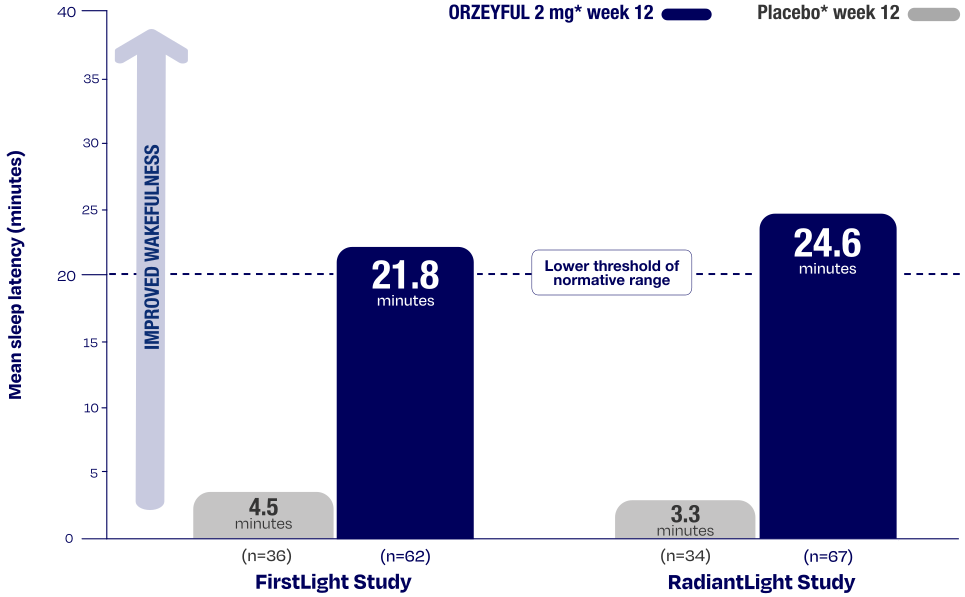
• Mean sleep latency for patients in the 1 mg* group was 19.3 minutes at 12 weeks (n=56)2
About MWT
MWT is a 40-minute test that measures an individual’s ability to remain awake during the day in a darkened, quiet environment1
- Sleep latency was determined as the mean number of minutes patients could remain awake across the 4 test sessions1
- Normative mean sleep latency is defined as ≥20 minutes. The normative range is based on thresholds defined in external literature; for descriptive context only. This analysis was not prespecified and not intended for statistical inference1,3,4
- Clinically significant improvement defined as an increase from baseline of >2 minutes1

Statistically significant improvements
in sustained wakefulness with ORZEYFUL 1 mg and 2 mg across both studies1
ORZEYFUL was evaluated in two phase 3, randomized, multicenter, double‑blind, placebo-controlled, 12‑week, parallel-group studies1
SECONDARY ENDPOINT
Daytime sleepiness: Statistically significant improvement1
As measured by the Epworth Sleepiness Scale (ESS) vs placebo at week 12 (P<0.001)1,2
Change from baseline vs placebo at week 121
Treatment arm | Baseline mean (SD) | LS mean difference from baseline vs placebo (95% CI) | |
FirstLight Study | 1 mg*† | 18.2 (2.6) points | -8.0 (-9.9, -6.1) |
| 2 mg*† | 19.0 (3.2) points | -9.8 (-11.6, -7.9) | |
| Placebo* | 18.2 (3.6) points | ||
RadiantLight Study | 2 mg*† | 17.3 (3.4) points | -9.5 (-11.1, -8.0) |
| Placebo* | 17.9 (3.0) points |
Treatment arm | |
FirstLight Study | 1 mg*† |
| 2 mg*† | |
| Placebo* | |
RadiantLight Study | 2 mg*† |
| Placebo* |
Baseline mean (SD) | |
FirstLight Study | 18.2 (2.6) points |
| 19.0 (3.2) points | |
| 18.2 (3.6) points | |
RadiantLight Study | 17.3 (3.4) points |
| 17.9 (3.0) points |
LS mean difference from baseline vs placebo (95% CI) | |
FirstLight Study | -8.0 (-9.9, -6.1) |
| -9.8 (-11.6, -7.9) | |
RadiantLight Study | -9.5 (-11.1, -8.0) |
*Twice daily, at least 3 to 5 hours apart.1
†Statistically significantly superior to placebo after adjusting for multiplicity.1
- In both studies, ORZEYFUL 1 mg and 2 mg significantly improved daytime sleepiness from baseline to week 12 compared to placebo1
Mean ESS total score at week 121-4
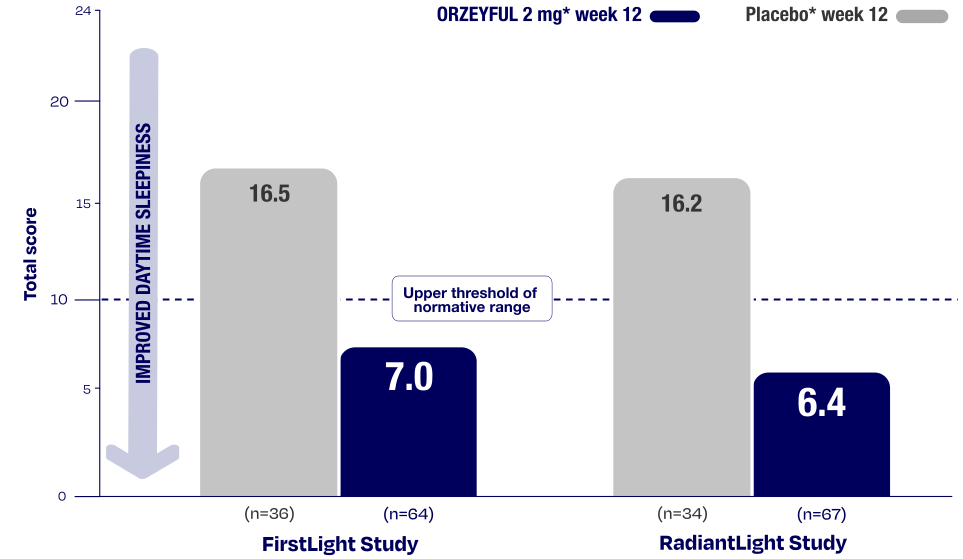
• Total ESS score 8.3 at 12 weeks for patients treated with ORZEYFUL 1 mg (n=57)*
About ESS
ESS is a self-reported 8-item questionnaire1
- Patients rate their perceived likelihood of falling asleep during daily activities1
- Score of ≤10 is considered within the normative range. The normative range is based on thresholds defined in external literature; for descriptive context only. This analysis was not prespecified and not intended for statistical inference1,3,4
- Reduction of 2 points from baseline is defined as a clinically significant improvement1

Statistically significant improvements
in daytime sleepiness with ORZEYFUL 1 mg and 2 mg across both studies1
ORZEYFUL was evaluated in two phase 3, randomized, multicenter, double‑blind, placebo-controlled, 12‑week, parallel-group studies1
SECONDARY ENDPOINT
Cataplexy: Statistically significant reduction in events1
As measured by the Weekly Cataplexy Rate (WCR) (P<0.001)1,2
WCR at week 121
Treatment group | Baseline mean (SD) | Week 12 mean (SD) | Incident rate ratio vs placebo (95% CI) | Relative reduction vs placebo | |
FirstLight Study | 1 mg*† | 38.3 (45.9) | 9.0 (12.2) | 0.34 (0.20, 0.57) | 66% |
| 2 mg*† | 41.6 (39.2) | 12.6 (18.6) | 0.38 (0.23, 0.61) | 62% | |
| Placebo* | 48.9 (56.6) | 28.3 (36.4) | |||
RadiantLight Study | 2 mg*† | 33.2 (39.6) | 7.1 (12.9) | 0.25 (0.15, 0.42) | 75% |
| Placebo* | 45.8 (40.1) | 29.2 (32.4) |
Treatment group | |
FirstLight Study | 1 mg*† |
| 2 mg*† | |
| Placebo* | |
RadiantLight Study | 2 mg*† |
| Placebo* |
Baseline mean (SD) | |
FirstLight Study | 38.3 (45.9) |
| 41.6 (39.2) | |
| 48.9 (56.6) | |
RadiantLight Study | 33.2 (39.6) |
| 45.8 (40.1) |
Week 12 mean (SD) | |
FirstLight Study | 9.0 (12.2) |
| 12.6 (18.6) | |
| 28.3 (36.4) | |
RadiantLight Study | 7.1 (12.9) |
| 29.2 (32.4) |
Incident rate ratio vs placebo (95% CI) | |
FirstLight Study | 0.34 (0.20, 0.57) |
| 0.38 (0.23, 0.61) | |
RadiantLight Study | 0.25 (0.15, 0.42) |
Relative reduction vs placebo | |
FirstLight Study | 66% |
| 62% | |
RadiantLight Study | 75% |
At week 12, patients treated with ORZEYFUL 1 mg or 2 mg demonstrated improvements in WCR1
At week 12, patients treated with ORZEYFUL 1 mg or 2 mg demonstrated improvements in WCR1
WCR from baseline to week 12 in FirstLight Study2
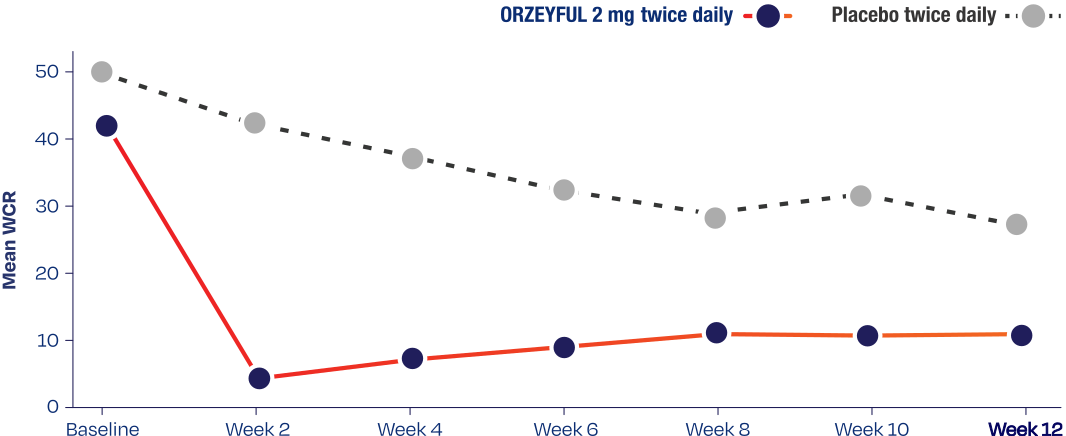
- The incidence rate ratio of weekly cataplexy rate in ORZEYFUL-treated patients relative to those taking placebo was prespecified only at week 121
WCR was self-reported; patients captured cataplexy events in a diary over 14-day periods1,2
- Clinically significant improvement defined as at least a 25% reduction in the frequency of daily or weekly episodes, based on diary entries
*Twice daily, at least 3 to 5 hours apart.1
†Statistically significantly superior to placebo after adjusting for multiplicity.1
ORZEYFUL was evaluated in two phase 3, randomized, multicenter, double‑blind, placebo-controlled, 12‑week, parallel-group studies1
SECONDARY ENDPOINT
Overall symptoms of NT1: Statistically significant improvements1
As measured by the Narcolepsy Severity Scale for Clinical Trials (NSS-CT) and Patient’s Global Impression of Change (PGI-C) (P<0.001 for all doses vs placebo at week 12)1,2
About NSS-CT
NSS-CT is a 15-item self-administered questionnaire that assesses the overall severity of these 5 narcolepsy symptoms1,3


About PGI-C
PGI-C is a self-administered questionnaire that assesses overall patient impression of symptom changes due to treatment relative to baseline1
- 7-point scale, centered at no change, and ranging from “very much worse” to “very much improved”
Recommended for you
The first phase 3 trials of an orexin receptor 2 agonist in patients with narcolepsy type 1 (NT1)
| Study design | Two randomized, phase 3, multicenter, double‑blind, placebo-controlled, 12‑week, parallel-group studies in adult patients with NT11
Study 1 included patients as young as 16 years of age1 |
| Washout criteria | Monotherapy study: Medications or supplements used for the treatment of NT1 were required to be discontinued prior to study start2 |
| Primary efficacy endpoint | Change from baseline to week 12 compared with placebo in mean sleep latency from the Maintenance of Wakefulness Test (MWT)1 |
Study design Two randomized, phase 3, multicenter, double‑blind, placebo-controlled, 12‑week, parallel-group studies in adult patients with NT11 Study 1 included patients as young as 16 years of age1 |
Washout criteria Monotherapy study: Medications or supplements used for the treatment of NT1 were required to be discontinued prior to study start2 |
Primary efficacy endpoint Change from baseline to week 12 compared with placebo in mean sleep latency from the Maintenance of Wakefulness Test (MWT)1 |
| Study 1 (FirstLight)1 | Study 2 (RadiantLight)1 | |
|---|---|---|
| Treatment arms | 168 PATIENTS Placebo twice daily (n=41) ORZEYFUL 1 mg twice daily (n=61) ORZEYFUL 2 mg twice daily (n=66) | 105 PATIENTS Placebo twice daily (n=35) ORZEYFUL 2 mg twice daily (n=70) |
| Baseline characteristics |
|
|
| Treatment arms |
| Study 1 (FirstLight)1 |
168 PATIENTS Placebo twice daily (n=41) ORZEYFUL 1 mg twice daily (n=61) ORZEYFUL 2 mg twice daily (n=66) |
| Study 2 (RadiantLight)1 |
105 PATIENTS Placebo twice daily (n=35) ORZEYFUL 2 mg twice daily (n=70) |
| Baseline characteristics |
| Study 1 (FirstLight)1 |
|
| Study 2 (RadiantLight)1 |
|
References: 1. ORZEYFUL (oveporexton tablets) prescribing information. Takeda Pharmaceuticals. 2. Data on File. Takeda Pharmaceuticals.
BID=twice a day; CI=confidence interval; ESS=Epworth Sleepiness Scale; FINI=Functional Impacts of Narcolepsy Instrument; LS=least squares; MWT=Maintenance of Wakefulness Test; NSS-CT=Narcolepsy Severity Scale for Clinical Trials; PGI-C=Patient’s Global Impression Scale; PVT=Psychomotor Vigilance Test; SF-36=36-Item Short Form Health Survey; WCR=Weekly Cataplexy Rate.
References: 1. ORZEYFUL (oveporexton tablets) prescribing information. Takeda Pharmaceuticals. 2. Data on File. Takeda Pharmaceuticals. 3. Doghramji K, Mitler MM, Sangal RB, et al. A normative study of the maintenance of wakefulness test (MWT). Electroencephalogr Clin Neurophysiol. 1997;103(5):554-562. doi:10.1016/s0013-4694(97)00010-2 4. Krahn LE, Arand DL, Avidan AY, et al. Recommended protocols for the Multiple Sleep Latency Test and Maintenance of Wakefulness Test in adults: guidance from the American Academy of Sleep Medicine. J Clin Sleep Med. 2021;17(12):2489-2498. doi:10.5664/jcsm.9620
BID=twice a day; CI=confidence interval; ESS=Epworth Sleepiness Scale; FINI=Functional Impacts of Narcolepsy Instrument; LS=least squares; MWT=Maintenance of Wakefulness Test; NSS-CT=Narcolepsy Severity Scale for Clinical Trials; PGI-C=Patient’s Global Impression Scale; PVT=Psychomotor Vigilance Test; SF-36=36-Item Short Form Health Survey; WCR=Weekly Cataplexy Rate.
References: 1. ORZEYFUL (oveporexton tablets) prescribing information. Takeda Pharmaceuticals. 2. Data on File. Takeda Pharmaceuticals. 3. Johns MW. A new method for measuring daytime sleepiness: the Epworth sleepiness scale. Sleep. 1991;14(6):540-545. doi:10.1093/sleep/14.6.540 4. Johns M, Hocking B. Daytime sleepiness and sleep habits of Australian workers. Sleep. 1997;20(10):844-849. doi:10.1093/sleep/20.10.844
BID=twice a day; CI=confidence interval; ESS=Epworth Sleepiness Scale; FINI=Functional Impacts of Narcolepsy Instrument; LS=least squares; MWT=Maintenance of Wakefulness Test; NSS-CT=Narcolepsy Severity Scale for Clinical Trials; PGI-C=Patient’s Global Impression Scale; PVT=Psychomotor Vigilance Test; SF-36=36-Item Short Form Health Survey; WCR=Weekly Cataplexy Rate.
References: 1. ORZEYFUL (oveporexton tablets) prescribing information. Takeda Pharmaceuticals. 2. Data on File. Takeda Pharmaceuticals.
BID=twice a day; CI=confidence interval; ESS=Epworth Sleepiness Scale; FINI=Functional Impacts of Narcolepsy Instrument; LS=least squares; MWT=Maintenance of Wakefulness Test; NSS-CT=Narcolepsy Severity Scale for Clinical Trials; PGI-C=Patient’s Global Impression Scale; PVT=Psychomotor Vigilance Test; SF-36=36-Item Short Form Health Survey; WCR=Weekly Cataplexy Rate.
References: 1. ORZEYFUL (oveporexton tablets) prescribing information. Takeda Pharmaceuticals. 2. Data on File. Takeda Pharmaceuticals. 3. Mahoney CE, Cogswell A, Koralnik IJ, Scammell TE. The neurobiological basis of narcolepsy. Nat Rev Neurosci. 2019;20(2):83-93. doi:10.1038/s41583-018-0097-x